
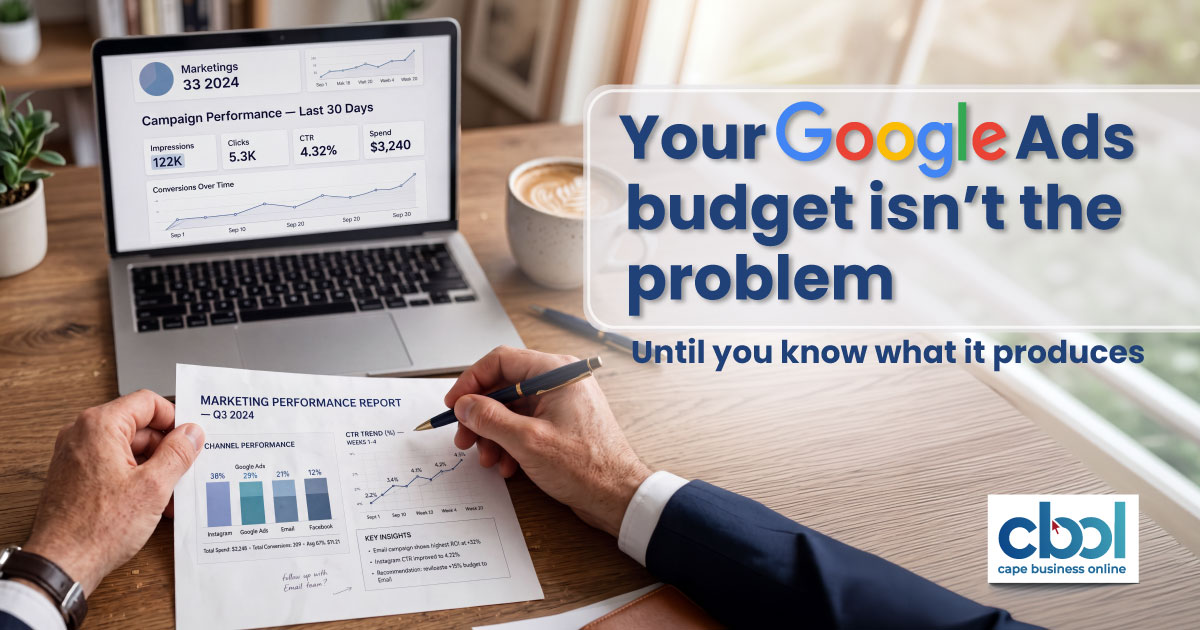
There is a conversation that plays out in businesses every month. Someone looks at the marketing expenditure, sees what is being spent on Google Ads and asks a perfectly reasonable question:
“Can we reduce this?”
The answer may well be yes. But there is another question that needs to be answered first:
“What is that money producing?”
Without that information, reducing advertising spend is not really optimisation. It is simply reducing a number on an expense report and hoping the corresponding reduction in leads is smaller, or non-existent. That is an uncomfortable way to make a marketing decision.
When is Google Ads actually expensive?
Suppose Business A spends R30,000 per month on Google Ads and Business B spends R10,000. Which business is spending too much? There is no sensible way to answer that question from those numbers alone.
If Business A’s advertising consistently generates commercially relevant enquiries that become profitable customers, while Business B generates clicks but very few genuine opportunities, the R10,000 campaign may actually be the more expensive one. Cost needs context.
The conversation therefore needs to move beyond “What are we spending?” to “What are we receiving in return?” That doesn’t mean every campaign should be protected from budget scrutiny. Quite the opposite. It means scrutiny needs to become much more precise.
There is a difference between cutting spend and cutting waste
Waste exists in paid search, and businesses should absolutely be looking for it. You may be paying for searches that have little commercial relevance to your business. Your geographic targeting may be bringing visitors from areas you don’t serve. Ads may be directing people to a generic homepage instead of a landing page that answers the specific question that prompted their search.
And sometimes the advertising has done its job perfectly well. Somebody clicked, only for the website to lose the opportunity through a slow page, confusing message, weak call to action or unnecessarily complicated enquiry process. Those are all reasons to optimise.
But there is an important distinction between removing money that isn’t working and removing money because the total feels uncomfortable.
The first is optimisation.
The second may inadvertently reduce the very activity generating the business’s sales opportunities.
A click is not the result
This is also why clicks alone are a poor way to judge whether advertising is successful. Clicks tell you that someone responded to an advertisement. They don’t necessarily tell you whether that person became a lead, made a phone call, submitted an enquiry or ultimately became a customer.
Modern conversion measurement can connect advertising interactions with actions that businesses define as valuable, including website enquiries, purchases and phone calls. It can also help identify which campaigns, ads and keywords are contributing to those actions.
The measurement will never be perfect, and not every customer journey can be neatly attributed to a single interaction. But the objective should be to close the gap between marketing activity and commercial outcome as far as reasonably possible.
The uncomfortable question: Which 30%?
Imagine a business generates 50 online enquiries each month. Management decides that economic conditions require a 30% reduction in marketing expenditure. Again, that may be entirely reasonable. But which 30% should go?
If nobody knows which channels, campaigns or search activity generated those 50 enquiries, there is no informed answer. The business could cut a campaign producing very little commercial value. Or it could cut the campaign responsible for a substantial proportion of its best leads. Both decisions reduce expenditure by exactly the same amount. Their consequences could be completely different.
That is why tracking should not be viewed as something marketers use to produce better-looking monthly reports. It exists to improve the quality of business decisions.
Marketing accountability works in both directions
There is another side to this argument that is equally important. Better measurement shouldn’t only be used to defend marketing budgets. If an activity isn’t producing results, the agency or marketing team should be willing to say so. Perhaps the campaign needs to change. Perhaps the landing page is the problem. Perhaps the audience is wrong. Perhaps the budget should move somewhere else. And sometimes an activity simply shouldn’t continue. Accountability cannot mean finding evidence to justify whatever is already being spent. It means using evidence to decide what deserves to be spent next.
Stop asking whether you can spend less
Every business should challenge its marketing expenditure. It should ask difficult questions about performance, efficiency and return. But “Can we reduce our Google Ads budget?” is usually not the best place to begin.
Start here instead:
Which marketing activities are producing commercially useful opportunities?
Where are we wasting money?
What could perform better with optimisation?
What happens to lead generation if we reduce an activity that is currently working?
Once those questions have credible answers, the budget conversation becomes much easier. Sometimes the evidence will tell you to spend less. Sometimes it will tell you to spend differently. Occasionally, it may even tell you that the sensible commercial decision is to invest more. The objective isn’t maximum marketing spend or minimum marketing spend. It is accountable marketing spend. And until you know what your Google Ads budget is producing, you don’t really know whether it is expensive at all.
About the author
Robert Haupt is the co-founder of Cape Business Online and has more than 20 years’ experience in digital marketing. His approach to Google Ads and lead generation is grounded in measurement: understanding which campaigns generate meaningful business opportunities and using that data to make better decisions about marketing spend.
Connect with him through LinkedIn
