
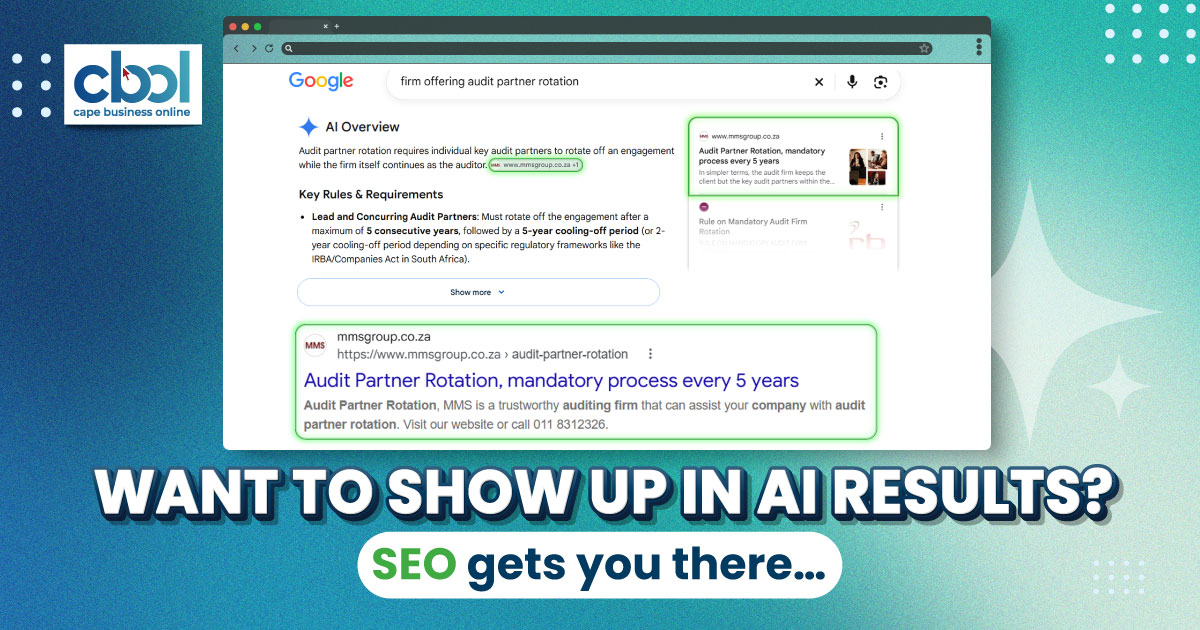
“I want to appear in AI answers, so surely I don’t need SEO anymore?”
It’s a question we hear increasingly, and it’s understandable. Tools like ChatGPT, Perplexity and Google’s AI Overviews now answer questions directly, often without the searcher visiting a single website.
But there’s a gap in that logic. AI doesn’t invent knowledge about your business. It finds it.
Where AI answers come from
AI assistants and AI search features build their answers from content that’s available online. When someone asks, “Who offers reliable office cleaning in Cape Town?” or “What should I look for in an accountant?”, the response is assembled from information the AI can find, read and trust.
For most businesses, the most important source of that information is their own website. Your Google Business Profile, online reviews, directory listings and articles that mention you all add to the picture, but your website is where your services, expertise and credibility are explained in your own words.
If your website is slow, poorly structured, thin on content or hard for search engines to crawl, AI has very little to work with. If a competitor’s website clearly explains their services, answers common customer questions and demonstrates real expertise, they’re far more likely to be the business that gets mentioned.
AI rewards what good SEO has always aimed for
AI systems favour sources that appear credible and authoritative. In practice, that means websites that are:
Technically sound, so they can be crawled, indexed and understood
Clearly structured, with content that answers real questions directly
Demonstrating expertise and trust, through case studies, reviews, qualifications and up-to-date information
Consistent, with the same business details across your website, Google Business Profile and directories
This is exactly what SEO sets out to achieve. Google itself states that “the best practices for SEO remain relevant” for its AI features, and that there are no additional requirements or special optimisations needed to appear in AI Overviews or AI Mode. In other words, the route into AI answers runs straight through good SEO.
How SEO has changed in an AI world
From keywords to questions. People ask AI tools full, conversational questions. Content now needs to be built around topics, and the real questions customers ask, not just individual keywords.
From rankings to references. Success is no longer measured only by where you rank on page one, but also by whether your business is cited or recommended in AI-generated answers.
Structure for machines as well as people. Clear headings, concise answers, FAQ sections and structured data help AI systems understand and extract your information accurately.
Authority beyond your website. Reviews, your Google Business Profile, mentions on reputable sites and consistent business information all strengthen the signals AI relies on.
Original, experience-based content. Generic content is easy for AI to reproduce from anywhere. Content that shares genuine expertise, local knowledge and first-hand experience is what sets a source apart.
The trade-off: more visibility, fewer clicks
It’s important to be upfront about one consequence. Featuring in AI results can reduce your organic search traffic.
When an AI tool pulls an answer from your content and shows it directly in the results, some people get what they need without clicking through to your website. Research from Pew Research Center (July 2025) found that Google users clicked on a traditional search result in 8% of visits when an AI summary appeared, compared with 15% when there was no summary. Only 1% of visits included a click on a link inside the AI summary itself.
Does that make AI visibility less valuable? Not at all. It means success should be measured differently:
Visibility still builds your brand. Being named in an AI answer puts your business in front of potential customers in the moment that they’re researching.
The visitors who do click are often further along. They’ve already had their basic questions answered and are closer to making contact.
Leads matter more than raw traffic. Enquiries, calls and bookings are a better measure of performance than visitor numbers alone.
And if you’re not in the answer, there’s a good chance a competitor is.
The bottom line
AI hasn’t replaced SEO. It has raised the stakes. The businesses that appear in AI answers are, overwhelmingly, the ones with well-optimised, authoritative websites that clearly explain who they are and what they do.
If you’d like to understand how visible your business is in both traditional search and AI results, our team at Cape Business Online can help you build an SEO strategy designed for how people search today.
About the author
Robert Haupt is the co-founder of Cape Business Online and has spent more than 20 years helping businesses get found online. He specialises in SEO, Google Ads, Meta advertising and strategic digital marketing, and has watched search change from simple keyword rankings to the AI-driven results we see today. His approach stays the same throughout: build visibility on solid foundations and let the data guide every decision.
Connect with him through LinkedIn
